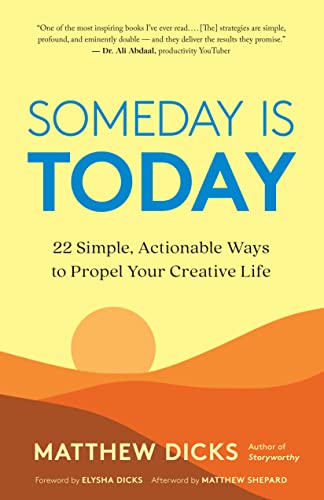
I heard about Matthew Dicks and this latest book of his when he was interviewed on a podcast series I listen to, and some of his ideas intrigued me.
In brief, Dicks has asked himself — and asks the reader — to think long ahead to being very old and lying on our deathbeds. Consider, he says, that you will of course be looking back at your life and thinking about everything you did. You’ll be happy with what had accomplished and what was fulfilling to you, and you’ll of course have regrets for things you think you could’ve/should’ve done better, or tried at all. The point of the exercise, he explains, is that you have the ability here and now to make that future version of yourself more happy and less regretful. Do more things now that you’ll be happy about doing later. Do less that you’ll regret.
In that vein, Dicks has spent an astounding amount of focus and energy over the years in experimenting with how to get the most needed tasks done in the least amount of time, in order to make more free time available to spend with his family and on creative pursuits like writing. He (very effectively) argues that, for instance, it’s rare or impossible for writers to get a significant block of time under absolutely perfect conditions to work on their writing. Whereas we all have free minutes here and there throughout our days — minutes waiting for the bus or in line for coffee or waiting for a meeting to start — when we can read a page or two of a novel or, as he does, write a few good sentences of his own new book.
Just five or ten minutes over the course of a whole day spent being productive instead of playing a game on your phone or scrolling social media can really add up. Suddenly within a week you’ve worked an hour more on your new book. A month of that and you’ve managed to get in half a workday of writing (or, again, whatever other creative pursuit you may enjoy). All from simply making use of little bits of formerly wasted time that become significant when given purpose. Little bits of time we normally fill with brain candy instead of using productively.
As a side note, this isn’t just a Matthew Dicks phenomenon, he just puts it together in a convincing package. Stephen King approximates that despite being hugely prolific, he still reads about 80 books a year, entirely by having one on hand at all times — on trips, while he’s waiting in line for anything, etc. — and using those tiny bits of time to read. Seconds and minutes add up to hours and days. Use it rather than lose it.
In this book, Dicks shares some of the ways he’s discovered to make more practical use of his free time throughout the day, asserting that we can do the same or similar. For him this sometimes includes doubling up activities that can be entirely or even partially overlap. Years ago he started flossing his in the shower, so that he always does it and saves a bit of time from doing the two things separately. (Fun fact: For decades I’ve been terrible at remembering, or caring to, floss. Upon reading this approach of his, I thought it was both silly and that it may still work. So I tried it. And I haven’t missed a shower/floss in the last few weeks since then, which is an unprecedented run of flossing for me. With no reason for it to stop.)
Dicks does allow that there’s of course got to be time for simply de-stressing and spending some idle time doing nothing of value. One can’t lead an enjoyable life wherein every second is accounted for and productive. But damn if he doesn’t get way closer than anyone I’ve ever read about.
I took a lot away from this book, and you may have the same experience with it, or even moreso. Whatever the case, I think we can all benefit from at least parts of what he’s proposing we all start doing. And hey, if you give it a shot and it isn’t for you, at least you tried it. One more thing for the future you to look back on and approve of.